> ## Documentation Index
> Fetch the complete documentation index at: https://docs.rocket.new/llms.txt
> Use this file to discover all available pages before exploring further.
# Netlify
> Connect Netlify to your Rocket.new app: deploy to a live URL with one click, automatic HTTPS, and global CDN.
export const LlmsDirective = () =>
For the complete documentation index, see llms.txt.
For a lightweight markdown version of this page, append .md to the URL.
;
Connect Netlify and deploy your web app with one click. Rocket handles the build and deployment automatically, so you go from project to live URL in seconds.
Rocket includes a default Netlify account for deployments. Connecting your own gives you full control over deployment history, custom domains, and the Netlify dashboard.
## What you can do
Publish your web app to a public Netlify URL with automatic HTTPS and global CDN. Your app is live in seconds.
After making changes in Rocket, deploy again to push the latest version to the same URL instantly.
After deploying, connect your own domain through the [Netlify dashboard](https://app.netlify.com) and update your DNS records.
## Connect Netlify
Netlify connects via OAuth, so no API key is needed. It is a **workspace-level** connector, so connect it once from Settings and it is available across all tasks.
Connect once from Settings and it is available across all tasks.
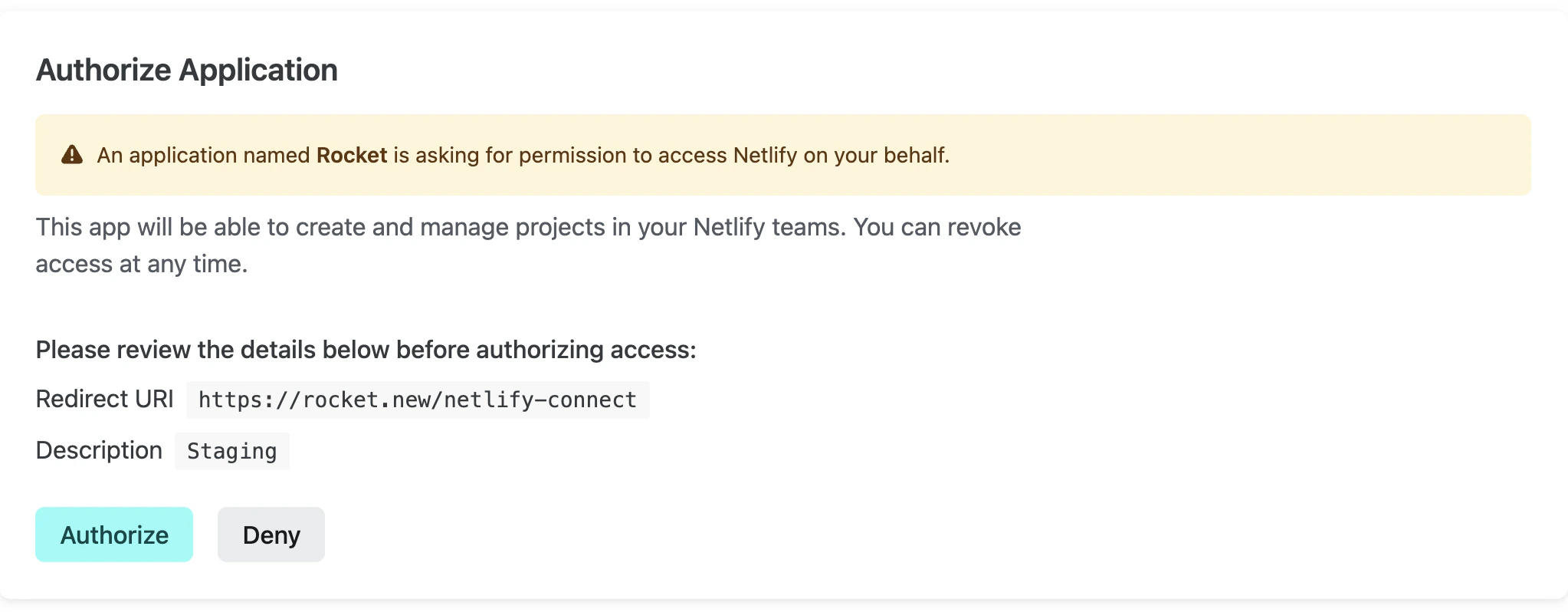
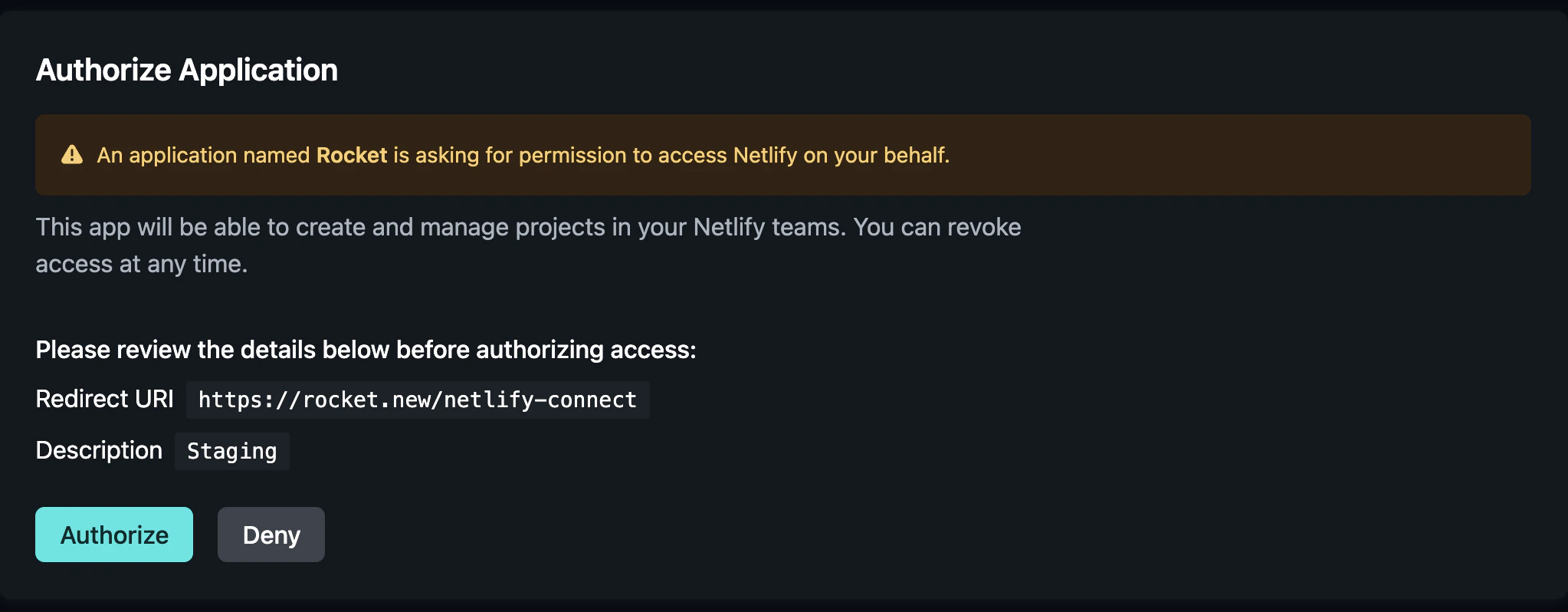
Click the **Netlify** card and click **Connect**. A Netlify authorization screen opens. Sign in if prompted, review the permissions, and click **Authorize**.
 A green dot appears next to Netlify when the connection is active.
**Disconnect**
Disconnect or switch accounts from workspace Settings.
## Deploy your task
Netlify deployment is triggered from the Rocket UI, not chat prompts. Click the **Launch** button in your task to publish.
Click the **Launch** button in the Rocket preview toolbar.
Pick the tab that matches your goal:
* **Staging** — deploy to a temporary URL for testing and sharing. See [Publish to staging](/build/launch-web/launch-your-site#publish-to-staging) for the full flow (publish, update, unpublish).
* **Production** — go live on your own domain. See [Custom domain](/build/launch-web/custom-domain) for setup instructions.
Rocket builds and deploys your app to a live Netlify URL automatically.
For a complete overview of the Launch dialog and release management, see [Launch your site](/build/launch-web/launch-your-site).
## Tips
* **Web apps only.** Netlify hosts web applications. Mobile apps built in Rocket cannot be deployed to Netlify.
* **Default account available.** If you do not connect your own Netlify account, Rocket uses a default one. Connect your own for full control over deployment history and custom domains.
* **Custom domains are configured in Netlify.** After deploying, go to the [Netlify dashboard](https://app.netlify.com) to connect a custom domain and update DNS records.
* **Build settings are automatic.** Rocket configures the correct build command and publish directory - no manual setup needed.
* **HTTPS is included.** All Netlify deployments come with free HTTPS certificates automatically.
## What's next?
Connect your own domain to your Netlify deployment.
Push your code to GitHub for version control alongside Netlify deployments.
Track visitors and page views on your live Netlify site with GA4.
Browse every available integration.
A green dot appears next to Netlify when the connection is active.
**Disconnect**
Disconnect or switch accounts from workspace Settings.
## Deploy your task
Netlify deployment is triggered from the Rocket UI, not chat prompts. Click the **Launch** button in your task to publish.
Click the **Launch** button in the Rocket preview toolbar.
Pick the tab that matches your goal:
* **Staging** — deploy to a temporary URL for testing and sharing. See [Publish to staging](/build/launch-web/launch-your-site#publish-to-staging) for the full flow (publish, update, unpublish).
* **Production** — go live on your own domain. See [Custom domain](/build/launch-web/custom-domain) for setup instructions.
Rocket builds and deploys your app to a live Netlify URL automatically.
For a complete overview of the Launch dialog and release management, see [Launch your site](/build/launch-web/launch-your-site).
## Tips
* **Web apps only.** Netlify hosts web applications. Mobile apps built in Rocket cannot be deployed to Netlify.
* **Default account available.** If you do not connect your own Netlify account, Rocket uses a default one. Connect your own for full control over deployment history and custom domains.
* **Custom domains are configured in Netlify.** After deploying, go to the [Netlify dashboard](https://app.netlify.com) to connect a custom domain and update DNS records.
* **Build settings are automatic.** Rocket configures the correct build command and publish directory - no manual setup needed.
* **HTTPS is included.** All Netlify deployments come with free HTTPS certificates automatically.
## What's next?
Connect your own domain to your Netlify deployment.
Push your code to GitHub for version control alongside Netlify deployments.
Track visitors and page views on your live Netlify site with GA4.
Browse every available integration.