

Build AI-powered features with a single prompt. Connect your OpenAI API key and describe what you want. Rocket handles all the API integration code automatically, so you can focus on defining what your AI features should do rather than writing boilerplate.You need:
What you can use it for
AI chat assistant
AI chat assistant
Add a conversational chatbot that answers user questions, provides recommendations, or guides users through workflows.Try this prompt:Rocket creates: chat UI with message history, OpenAI API calls with context management, and conversation storage.
Content generation tool
Content generation tool
Let users generate blog posts, marketing copy, product descriptions, or social media content from simple prompts.Try this prompt:Rocket creates: input form for topic and tone, OpenAI completion call, and formatted output display with copy-to-clipboard.
Document summarizer
Document summarizer
Upload documents or paste text and get concise summaries, key takeaways, or action items extracted automatically.Try this prompt:Rocket creates: text input area, OpenAI summarization call, and structured output with summary and action items.
AI-powered search
AI-powered search
Build semantic search that understands user intent instead of just matching keywords.Try this prompt:Rocket creates: search UI, OpenAI embedding or completion call for query understanding, and ranked results display.
Customer support bot
Customer support bot
Automate first-line support with a bot that answers FAQs, triages issues, and escalates complex requests.Try this prompt:Rocket creates: chat interface, OpenAI-powered response generation with knowledge base context, and escalation flow.
Get your OpenAI API key
Open the OpenAI dashboard to create or copy your API key.
Detailed setup
- Web Browser
- Mobile App
Connect OpenAI to Rocket
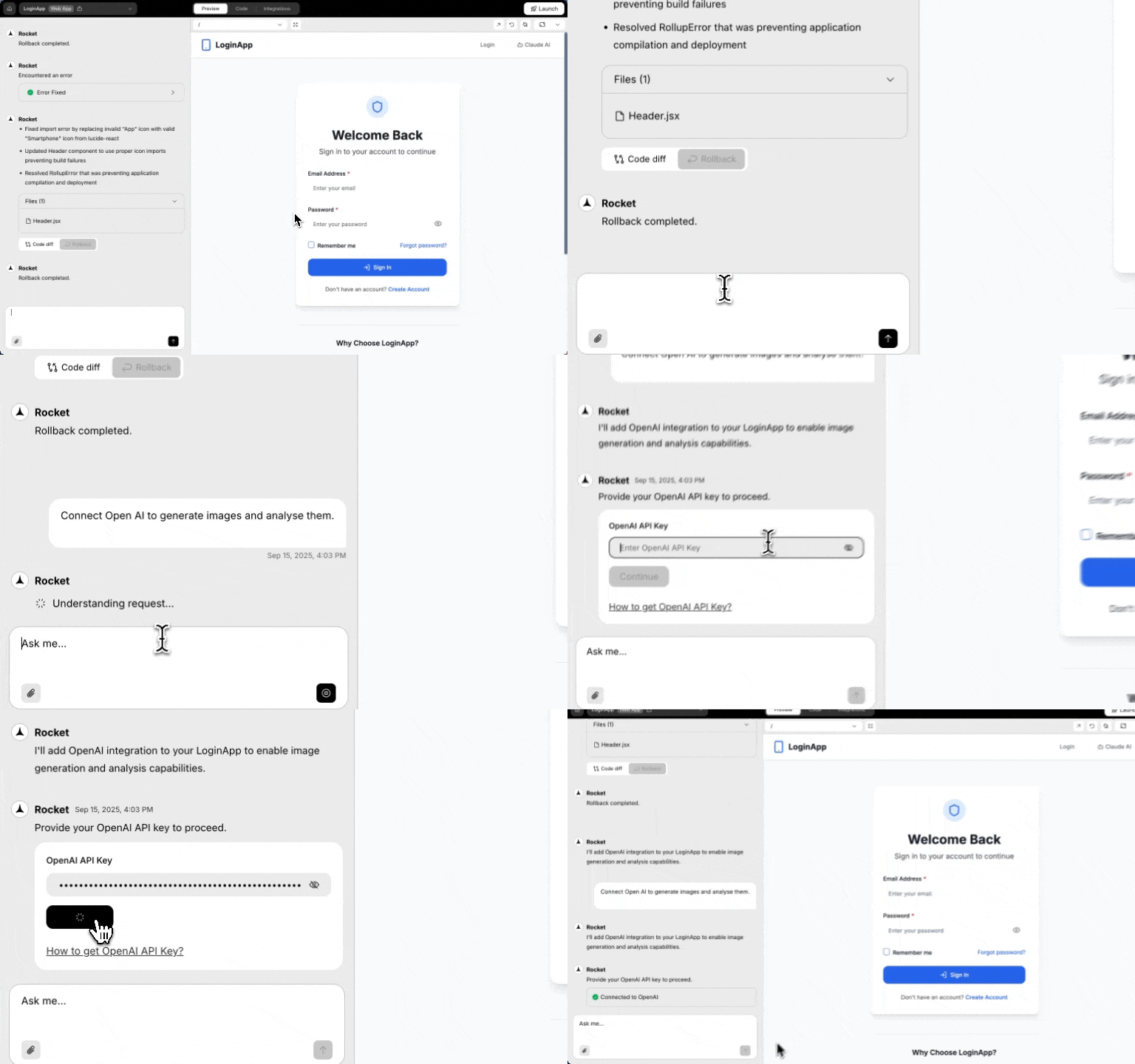
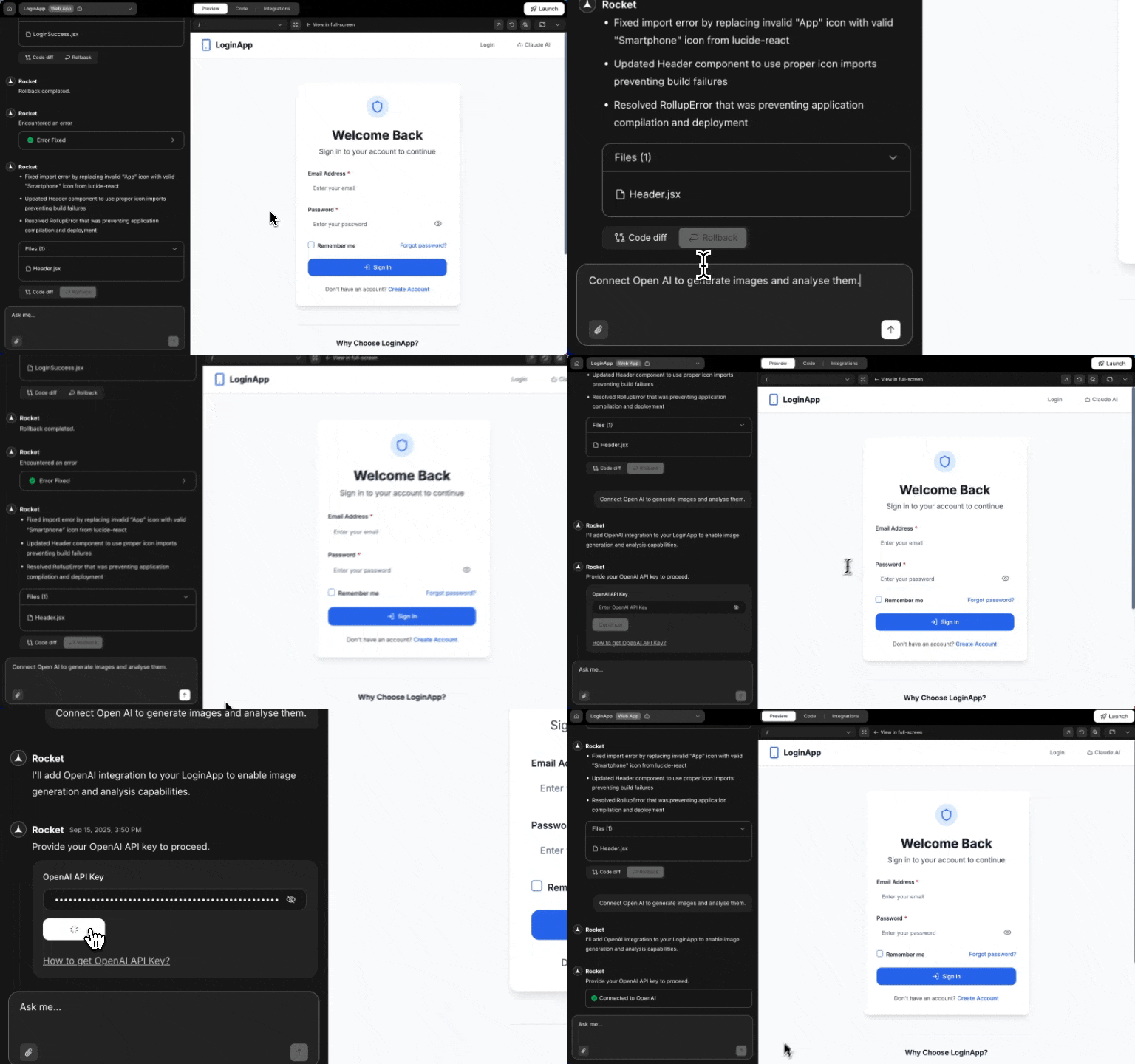
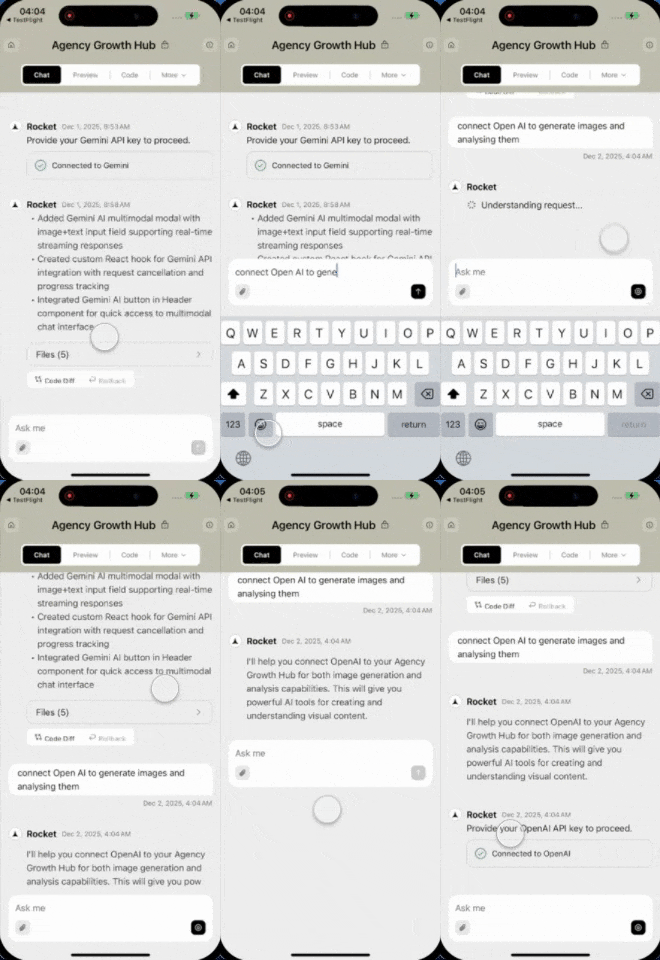
There are two ways to connect OpenAI to Rocket:Method 1: Use Rocket Chat (fastest)-
In any project, open the chat panel and type something like:
Connect OpenAI to: -
Add a GPT-powered chat assistant to my app. -
Generate summaries of user-uploaded documents. -
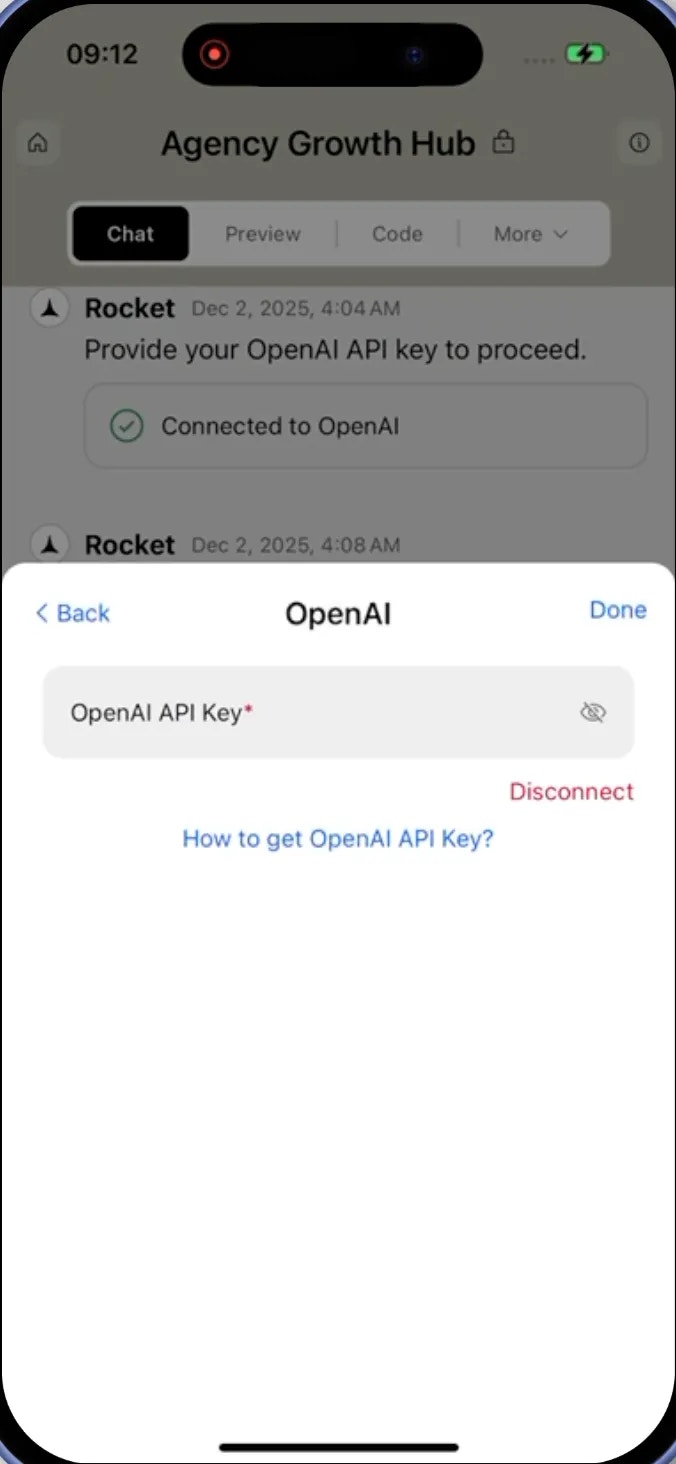
Rewrite user input with tone and clarity options. - You will see a popup appear where you can paste and save your API key instantly.
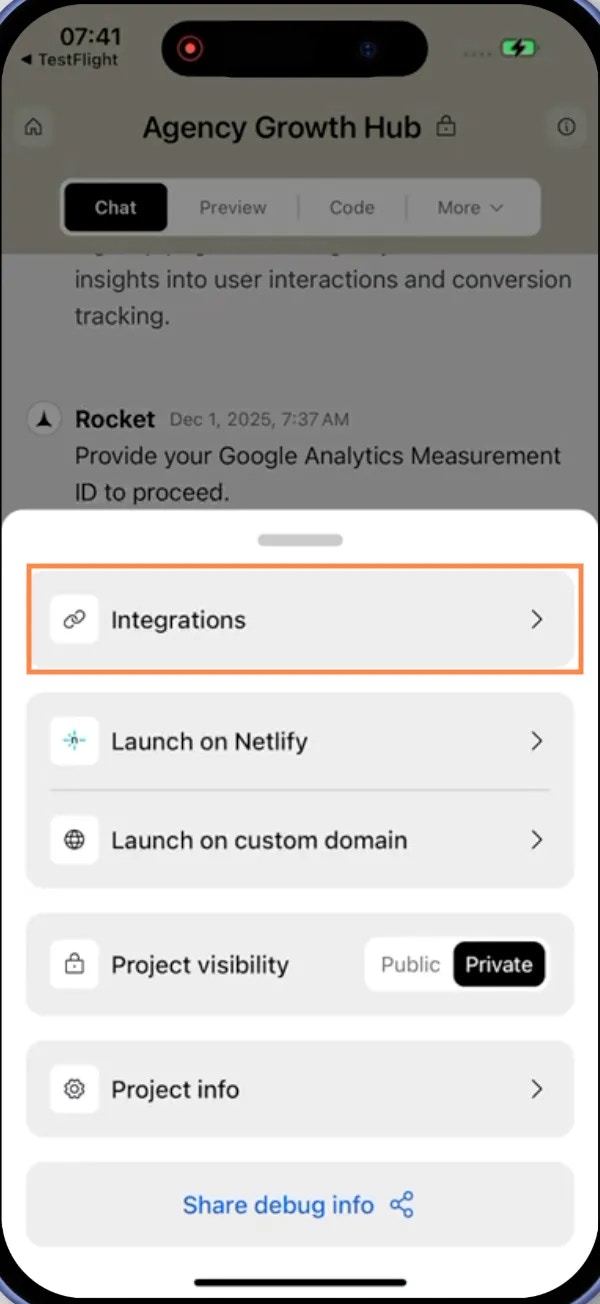
- Open any project and go to Integrations.
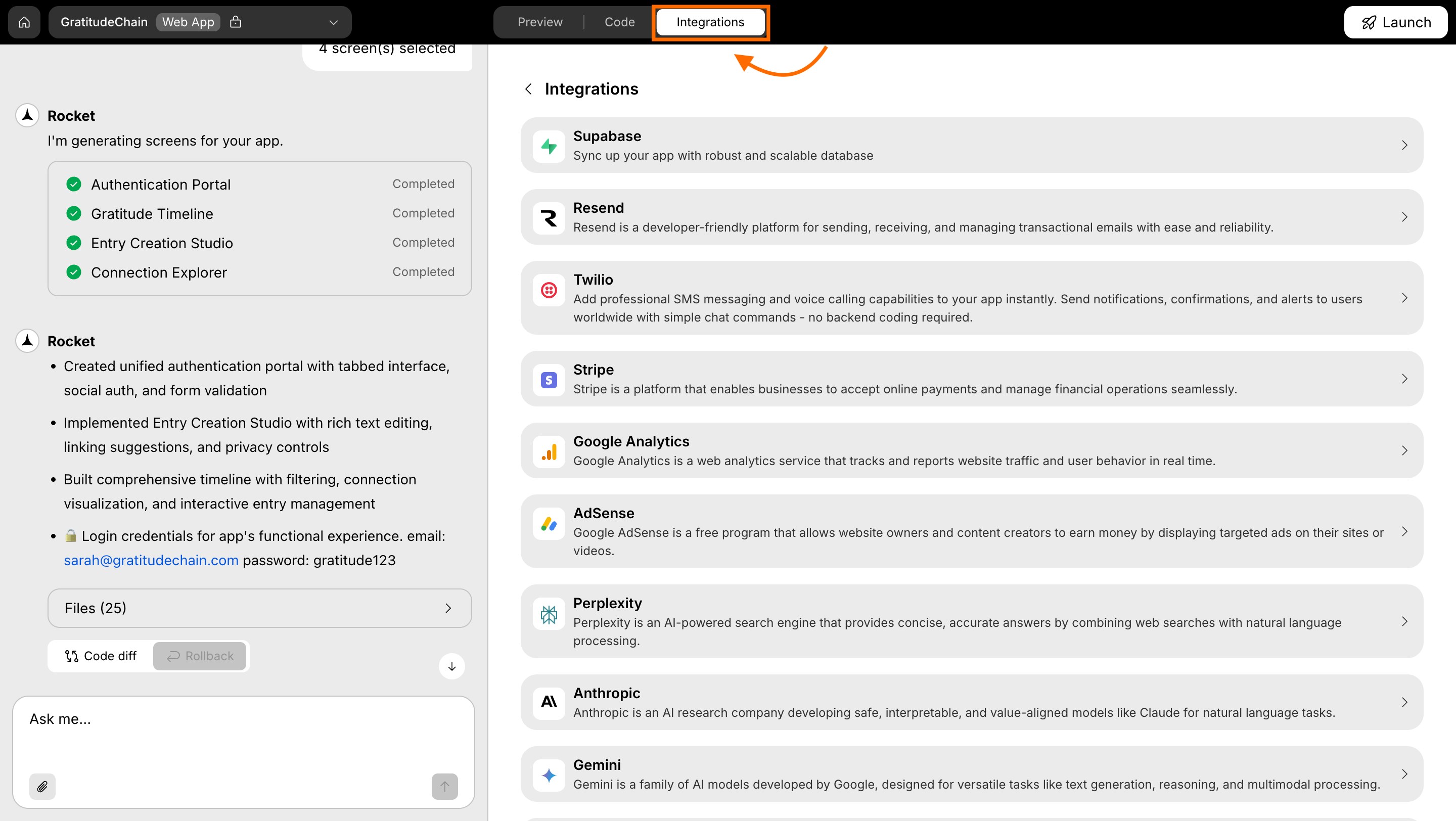
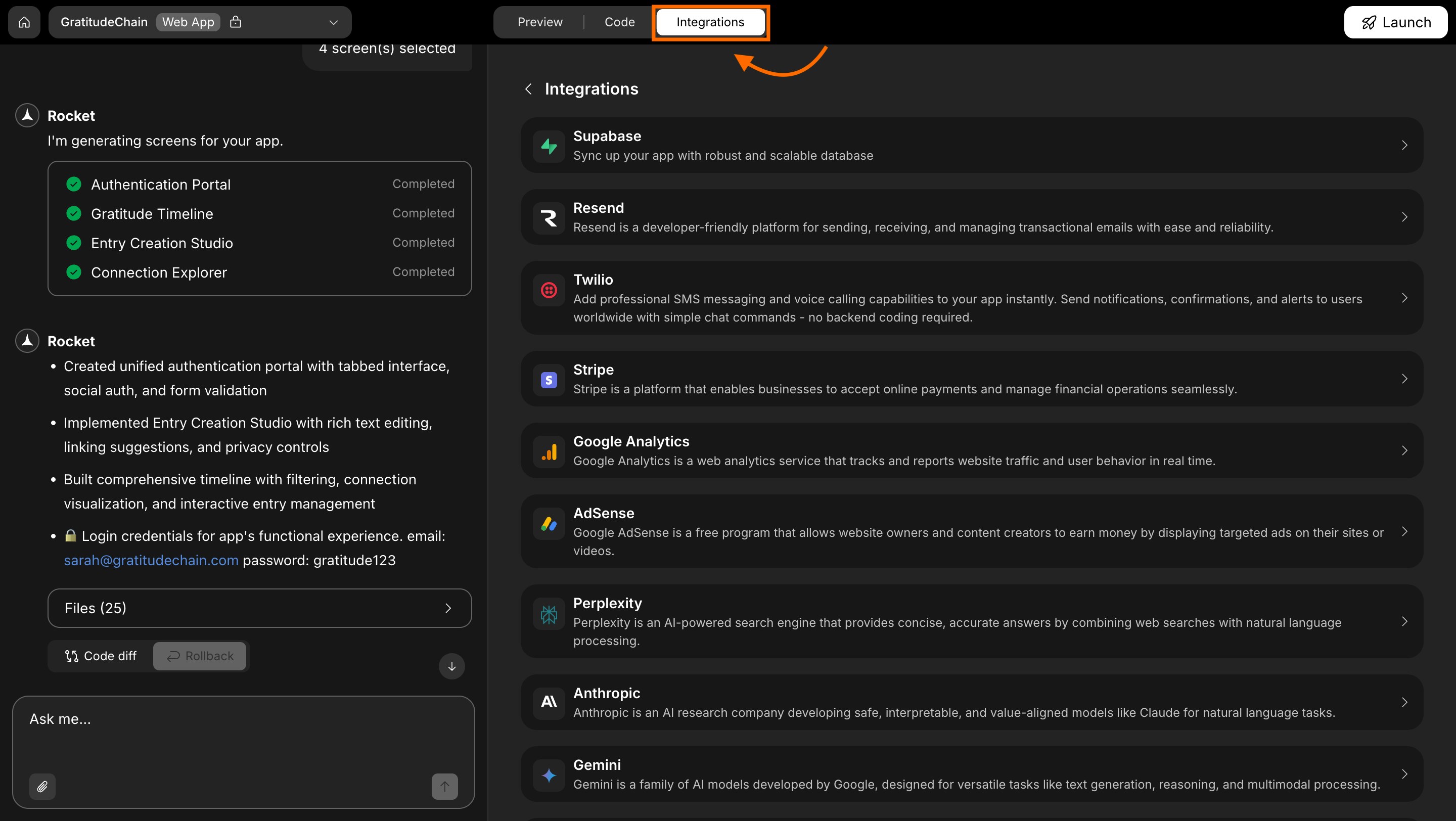
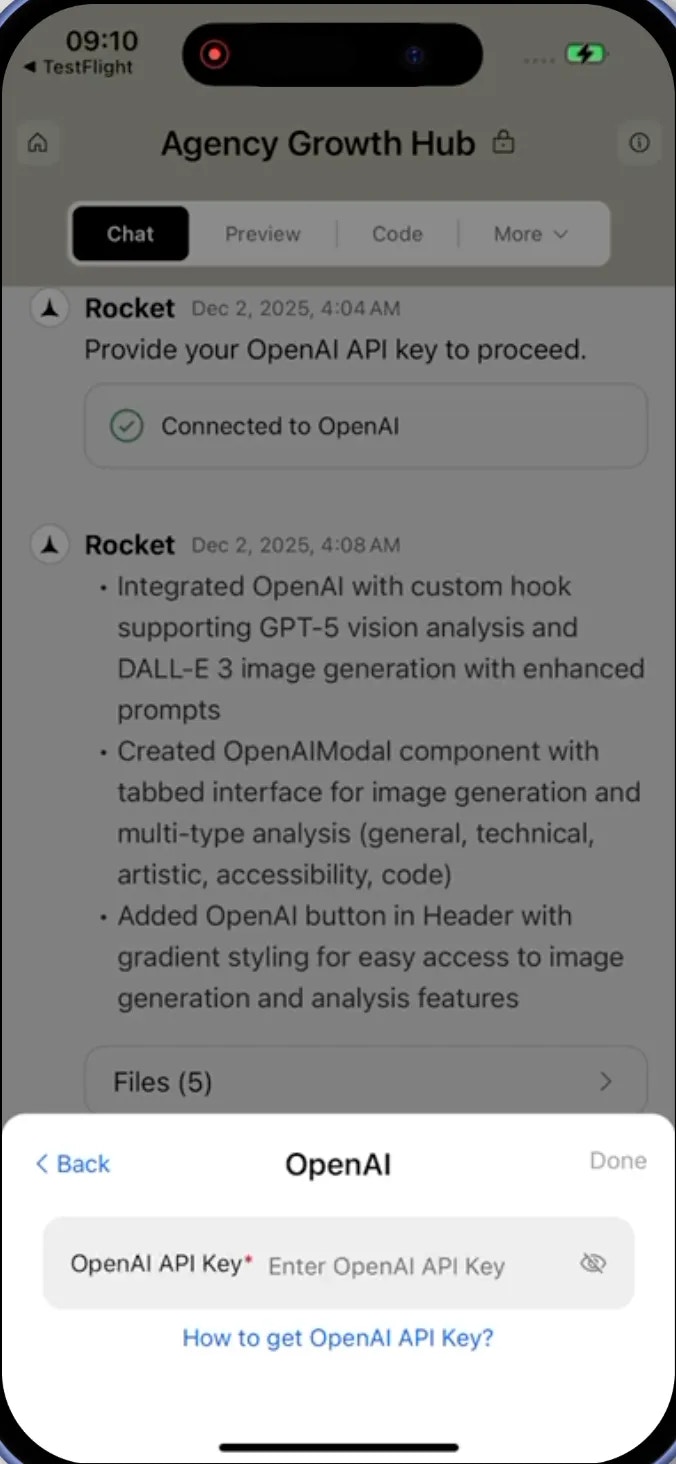
- Click the OpenAI card.
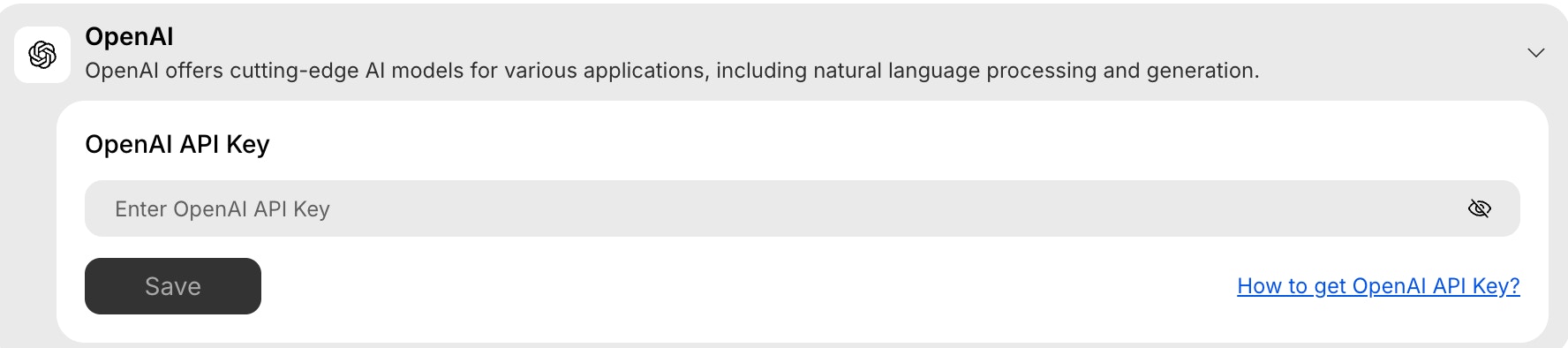
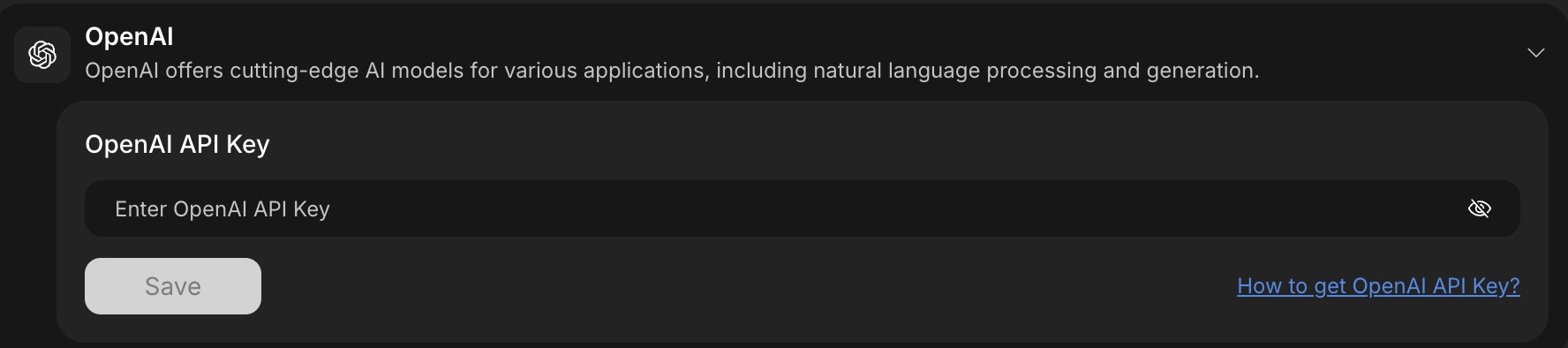
When you connect OpenAI from Project Settings, Rocket will not automatically create GPT features.
After saving your key, describe what you want in chat and Rocket will build it for you.
Save your OpenAI API key
- Paste your API key into the field.
- Click Save to complete setup.
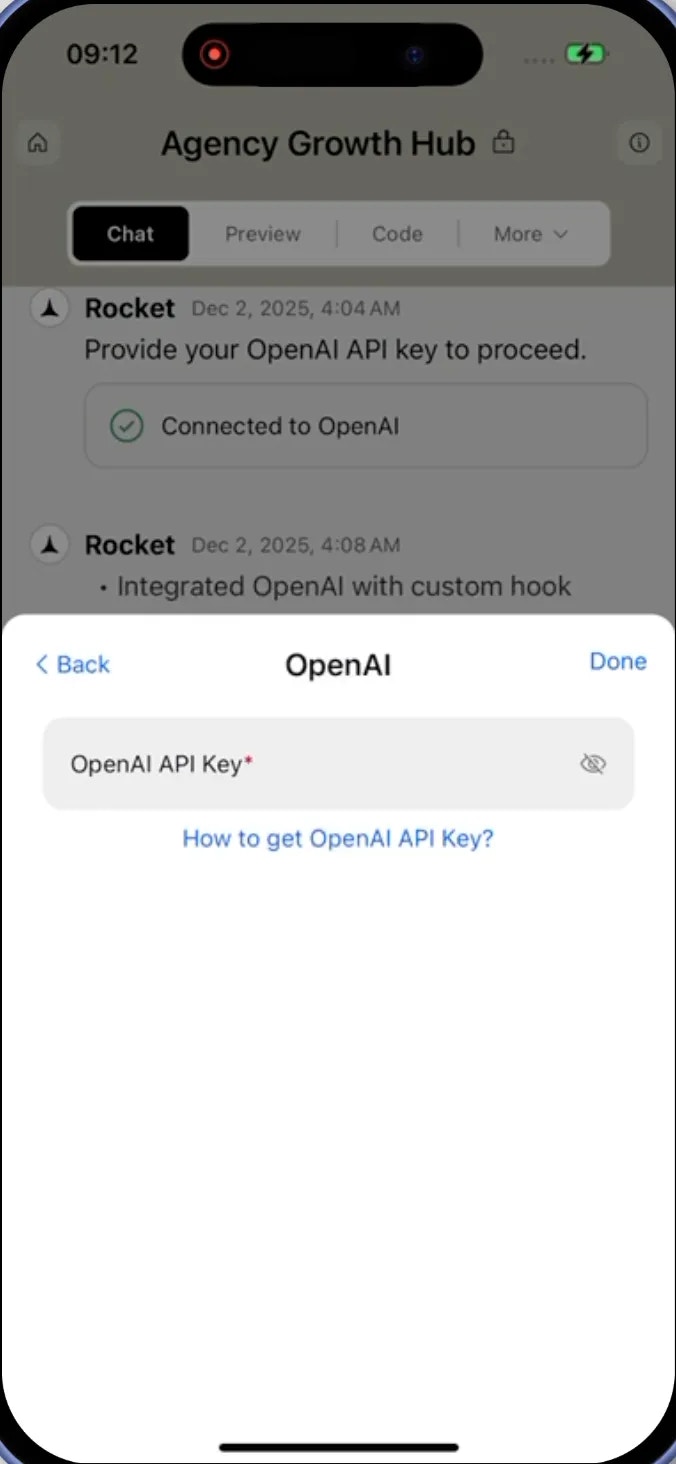
Update or disconnect
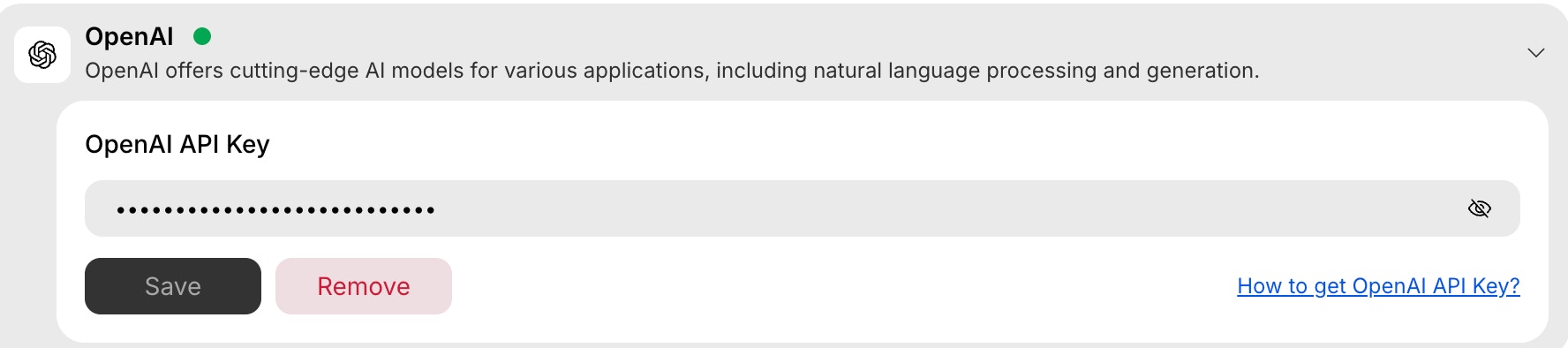
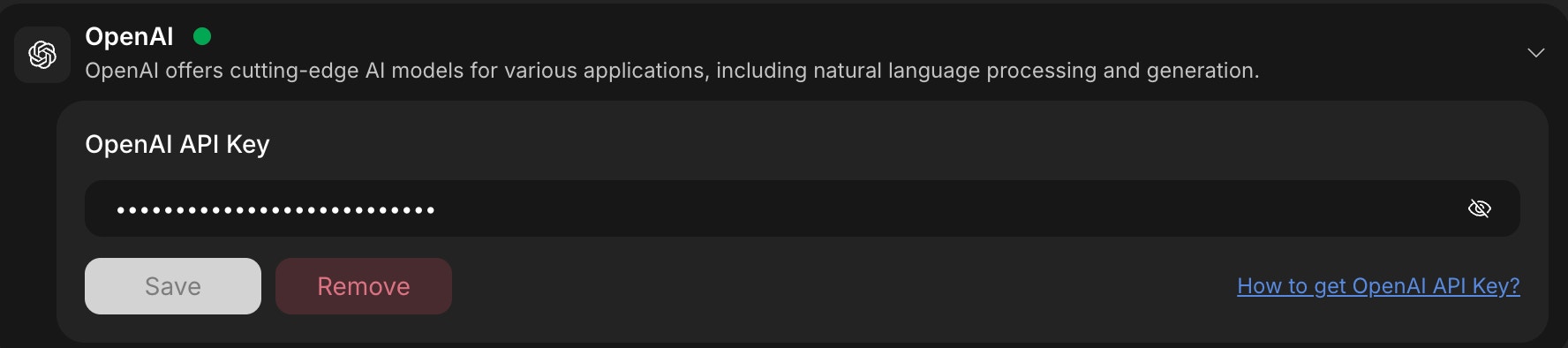
- Click the OpenAI integration again.
- Replace the existing key or click Remove to disconnect.
Prompt cookbook
Copy-paste these prompts after connecting OpenAI to build common AI features:| Use case | Prompt |
|---|---|
| Chatbot | Add an AI chatbot to my app that answers user questions using OpenAI GPT. |
| Blog writer | Build a blog post generator where users enter a topic and get a full draft from OpenAI. |
| Email drafter | Create an email composer that generates professional emails from bullet points using GPT. |
| Code explainer | Add a code explainer tool where users paste code and get a plain-English explanation from OpenAI. |
| Content moderator | Use OpenAI to automatically flag inappropriate user-submitted content before it is published. |
| Quiz generator | Build a quiz generator that creates multiple-choice questions from any topic using GPT. |
| Language translator | Add a translation feature that converts user text between languages using OpenAI. |
| Sentiment analyzer | Analyze customer feedback sentiment using OpenAI and display results in a dashboard. |
| Meeting summarizer | Summarize meeting notes into key decisions and action items using GPT. |
| Product description writer | Generate product descriptions from basic details like name, category, and features using OpenAI. |
Tips and limitations
- API key billing is separate. OpenAI charges based on usage (tokens processed). Monitor your spending in the OpenAI usage dashboard.
- Rate limits apply. New OpenAI accounts have lower rate limits. If your app serves many users, check your rate limit tier and request an increase if needed.
- Model selection. Rocket auto-selects the best available GPT model for your task. The latest models in the GPT-5 family offer significant improvements in reasoning, coding, and multimodal understanding over previous generations. You can specify a model preference in your prompt if needed.
- Token costs vary by model. Longer prompts and responses cost more. Keep system prompts concise and set reasonable max token limits for responses.
- OpenAI vs. Anthropic. GPT models excel at broad general-purpose tasks, function calling, and vision. Claude models are better suited for long-context analysis and tasks that benefit from more cautious, detailed responses.
What’s next?
Anthropic
Add Claude models for long-context analysis and detailed reasoning alongside GPT.
Gemini
Connect Google’s Gemini models for multimodal AI features.
Perplexity
Add real-time web search and up-to-date answers to your AI features.
Supabase
Store conversation history, user preferences, and AI-generated content in Supabase.