Rocket reads your Google content and writes outputs back. Most integrations are one-directional. Google Workspace with Rocket works both ways, collapsing entire workflows into a single step.Rocket reads: Docs, Sheets, Drive, and Calendar to build with real context. Your existing Google content becomes the source of truth for everything Rocket generates.Rocket writes back: Generated copy goes to Docs for team review, SEO metadata goes to Sheets, and brand assets upload to Drive.Prerequisites: A Rocket account at rocket.new and a Google account with access to the Docs, Sheets, Drive, or Calendar content you want to use.
  1. Content lives in a Google Doc
  2. You read it and extract the important parts
  3. You write a prompt describing what you want
  4. Rocket generates based on your description
The difference: Rocket works from your actual content, not your summary of it. Every detail, every nuance, every specific phrase your team chose carries through.

What you can use it for

Reading from Google

Stop building with lorem ipsum. Point Rocket at the Google Doc where your team already wrote the hero headline, feature descriptions, and pricing copy. Rocket reads it and replaces every placeholder with your real brand messaging.Try this prompt:
Read my brand messaging doc at [DOCS_URL] and replace all placeholder
text on this landing page with real copy. Update the hero headline,
subtext, feature descriptions, and pricing section to match the doc.
Works well for: hero sections, feature grids, pricing pages, about pages, and any section where your marketing team already wrote the copy somewhere else.
Spreadsheets are everywhere. Your marketing team tracks campaigns in one, product keeps a pricing matrix in another, and operations runs inventory from a third. Rocket reads the columns, rows, and data types, then generates a working app on top of it.Try this prompt:
Connect my Google Sheet at [SHEETS_URL] with product inventory data
and build a catalog page with search, category filters, and a detail
view for each product. Include stock status and pricing.
Works well for: campaign trackers, product pricing sheets, inventory managers, team directories, event lists, and any structured data your team already maintains in Sheets.
Your team writes PRDs, product briefs, and feature specs in Google Docs. Instead of reading the spec and then describing it to Rocket, let Rocket read the spec directly and build what it describes.Try this prompt:
Read the product requirements document at [DOCS_URL] and build the
described feature. Include every user story, the data model from the
technical section, and the UI described in the wireframe notes.
Rocket reads the full document structure: headings, tables, checklists, and embedded content. It generates matching pages, components, and data models.
Build booking systems, event pages, and availability checkers that pull directly from Google Calendar. No fake data or hardcoded times.Try this prompt:
Build a meeting scheduler that checks my Google Calendar for real-time
availability and lets visitors book 30-minute or 60-minute slots. Include
time zone detection and a confirmation email.
Rocket reads: calendar events, availability windows, and time zones. It generates scheduling UI with live availability checks.
Your brand photos, logos, and product images are already in Drive. Rocket can pull them in and replace placeholder visuals with your actual assets.Try this prompt:
Replace all placeholder images on this site with real brand assets from
my Google Drive folder at [DRIVE_URL]. Use the logo for the navbar, team
photos for the about page, and product shots for the features section.
Works well for: logos, team headshots, product photography, social proof screenshots, and any visual asset your team already organized in Drive.

Writing back to Google

Rocket generates great copy, but your marketing team needs to review it before it goes live. Send the generated text straight to a Google Doc where the team can comment, edit, and approve.Try this prompt:
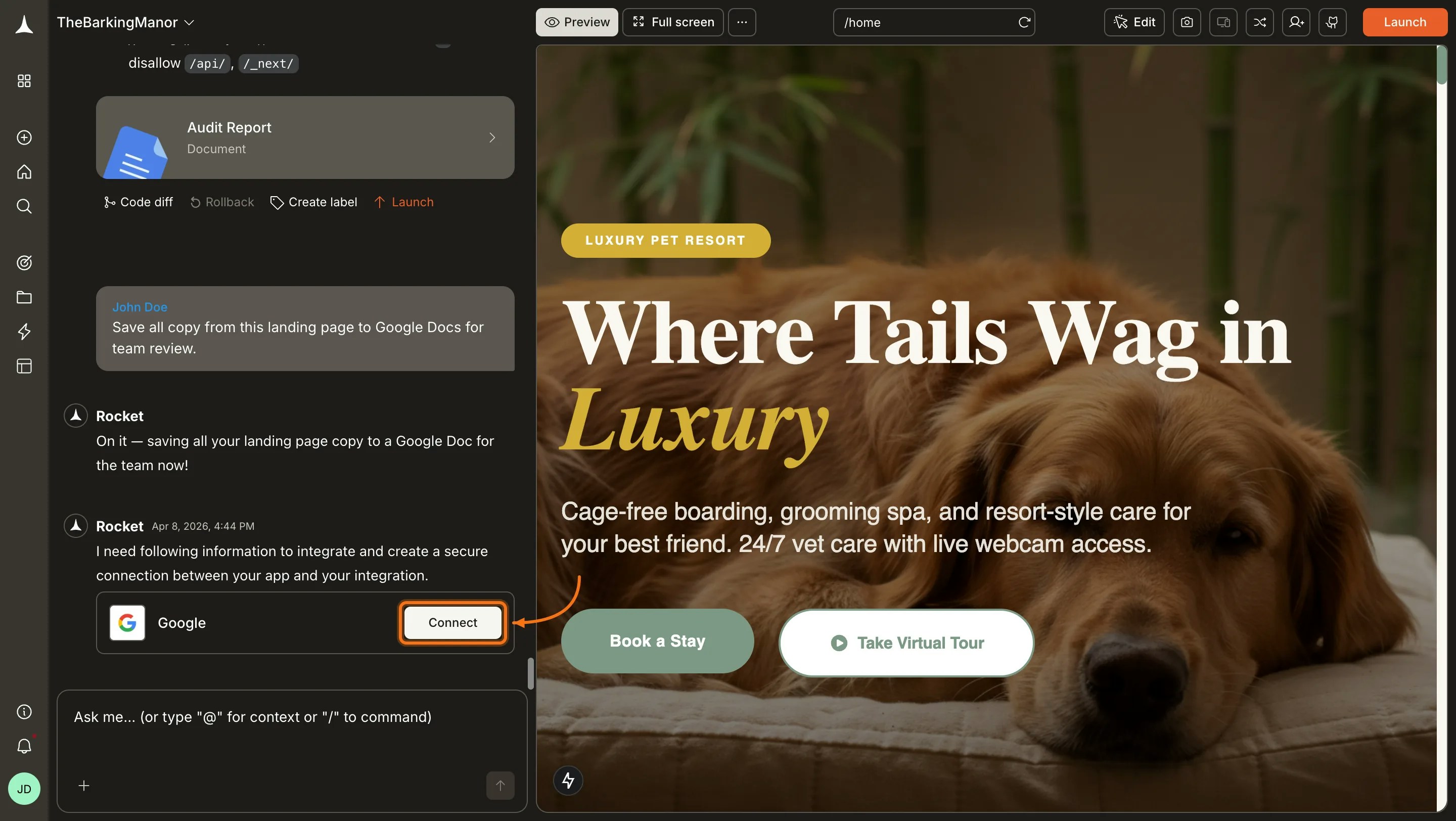
Save all the marketing copy from this landing page to a new Google Doc.
Organize it by section: hero, features, pricing, testimonials, FAQ, and
footer. Include the headlines, body text, and CTAs for each.
Works well for: marketing copy review, ad copy approval, email sequence drafts, and any content that needs a second pair of eyes.
Your SEO team lives in spreadsheets. After Rocket generates pages, export every title tag, meta description, and keyword target to a Google Sheet they can audit.Try this prompt:
Extract all SEO metadata from this website and save it to a Google Sheet.
Include columns for page URL, title tag, meta description, H1, and
target keywords. Add a row for every page.
This gives your SEO team a single spreadsheet to review, annotate, and send back with changes.
When building for clients, export the entire content structure to a spreadsheet. Every section, headline, body paragraph, and CTA in one place for easy review and sign-off.Try this prompt:
Export the full content structure of this site to a Google Sheet. Each
row should have: page name, section name, headline, body text, CTA text,
and CTA link. Include every section across all pages.
Clients can review, leave comments in the sheet, and you can re-import their changes.

Detailed setup

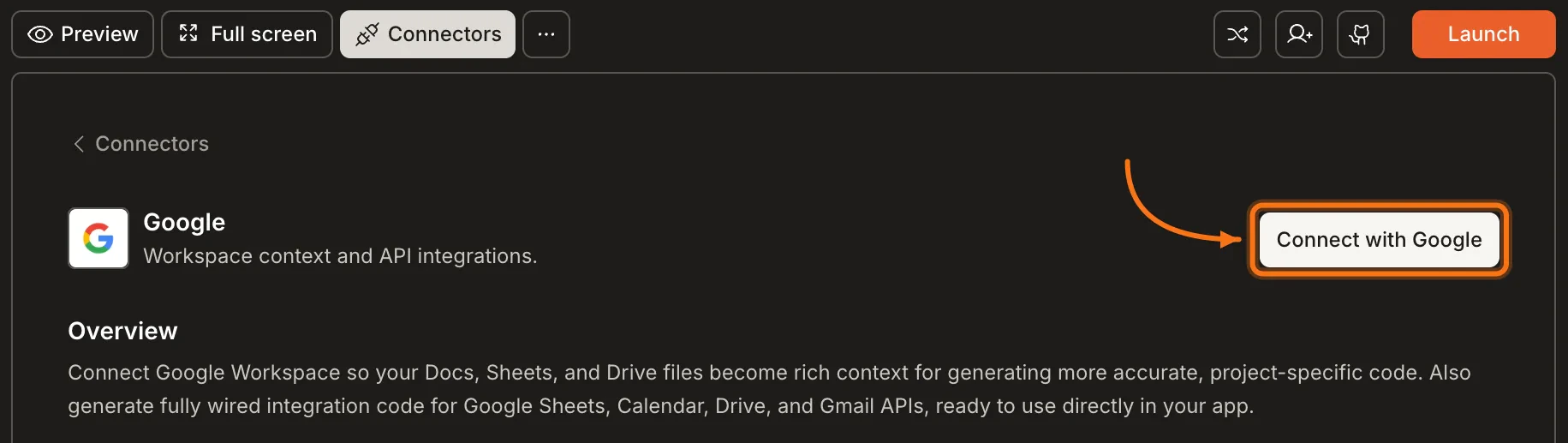
Google Workspace connects through OAuth. You will authorize Rocket through Google’s login flow, so no API key is needed.

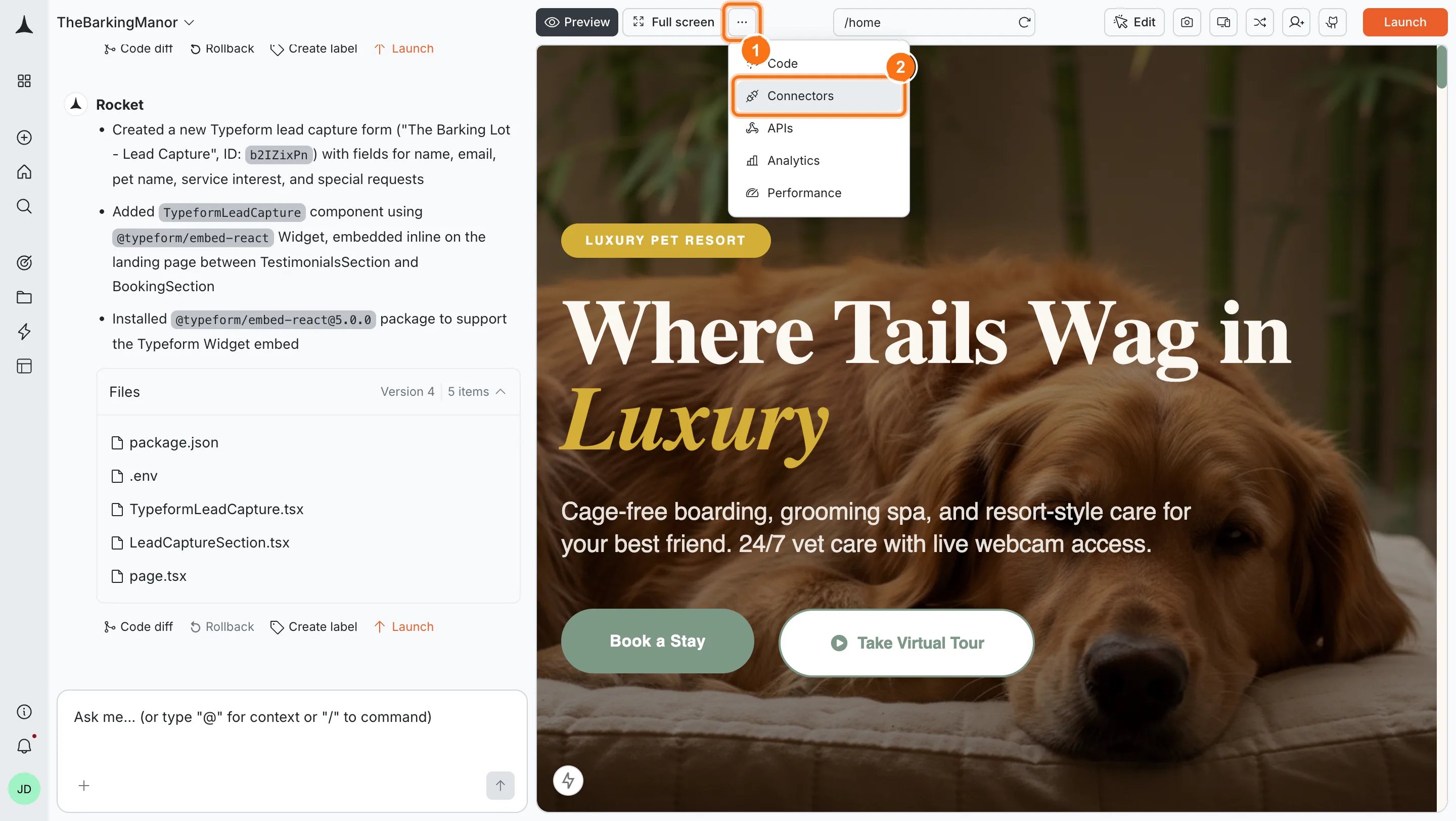
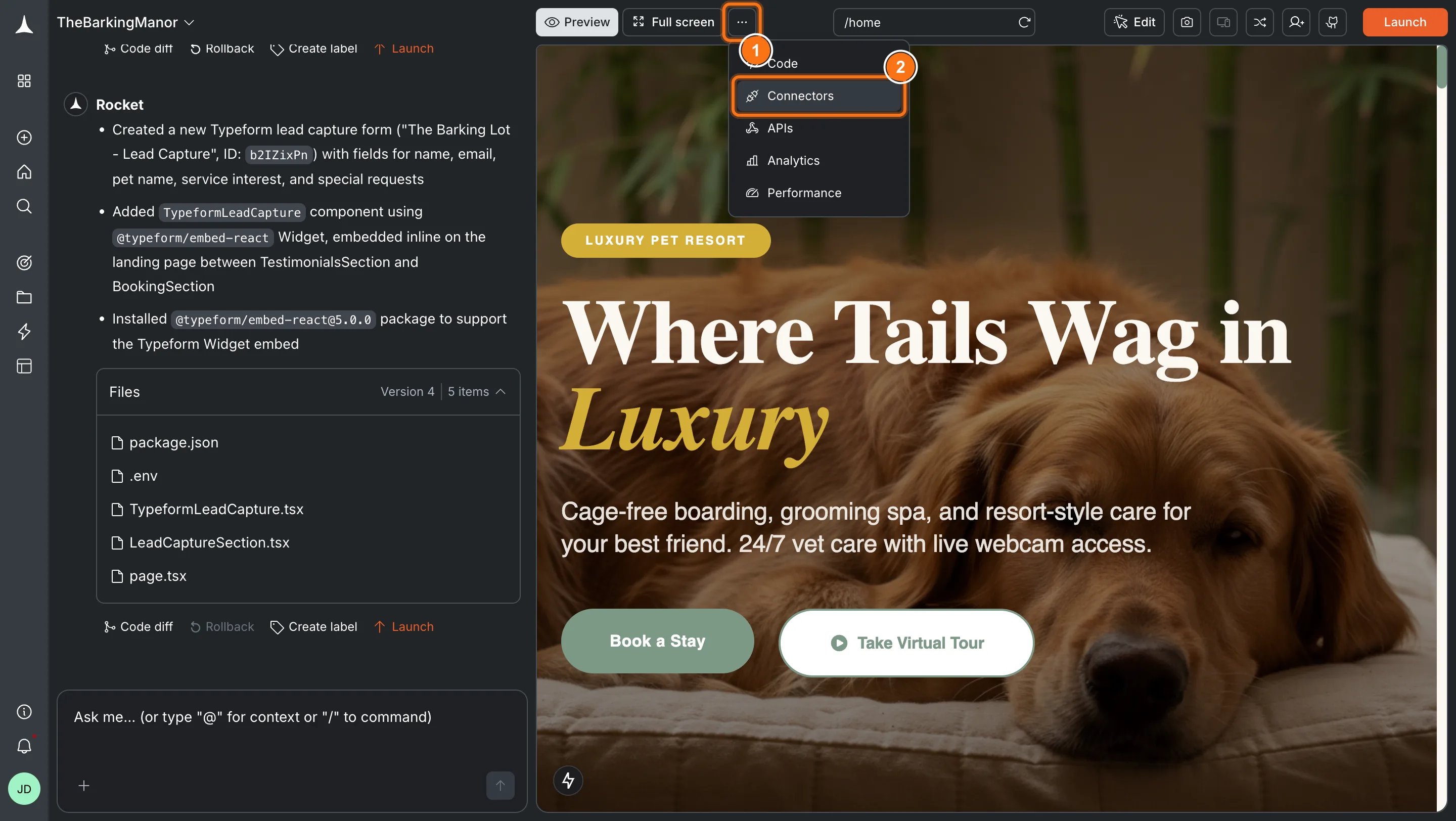
Open Integrations

  • Open any project.
  • Go to Integrations.
  • Click the Google Workspace card.

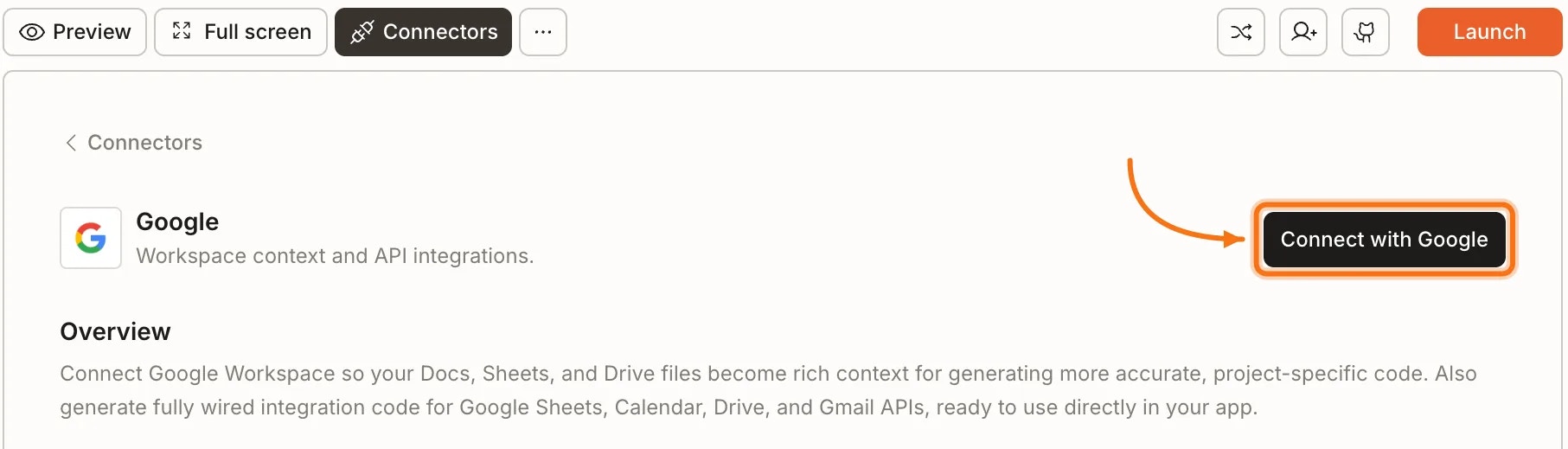
Authorize Google

  • Click Connect.
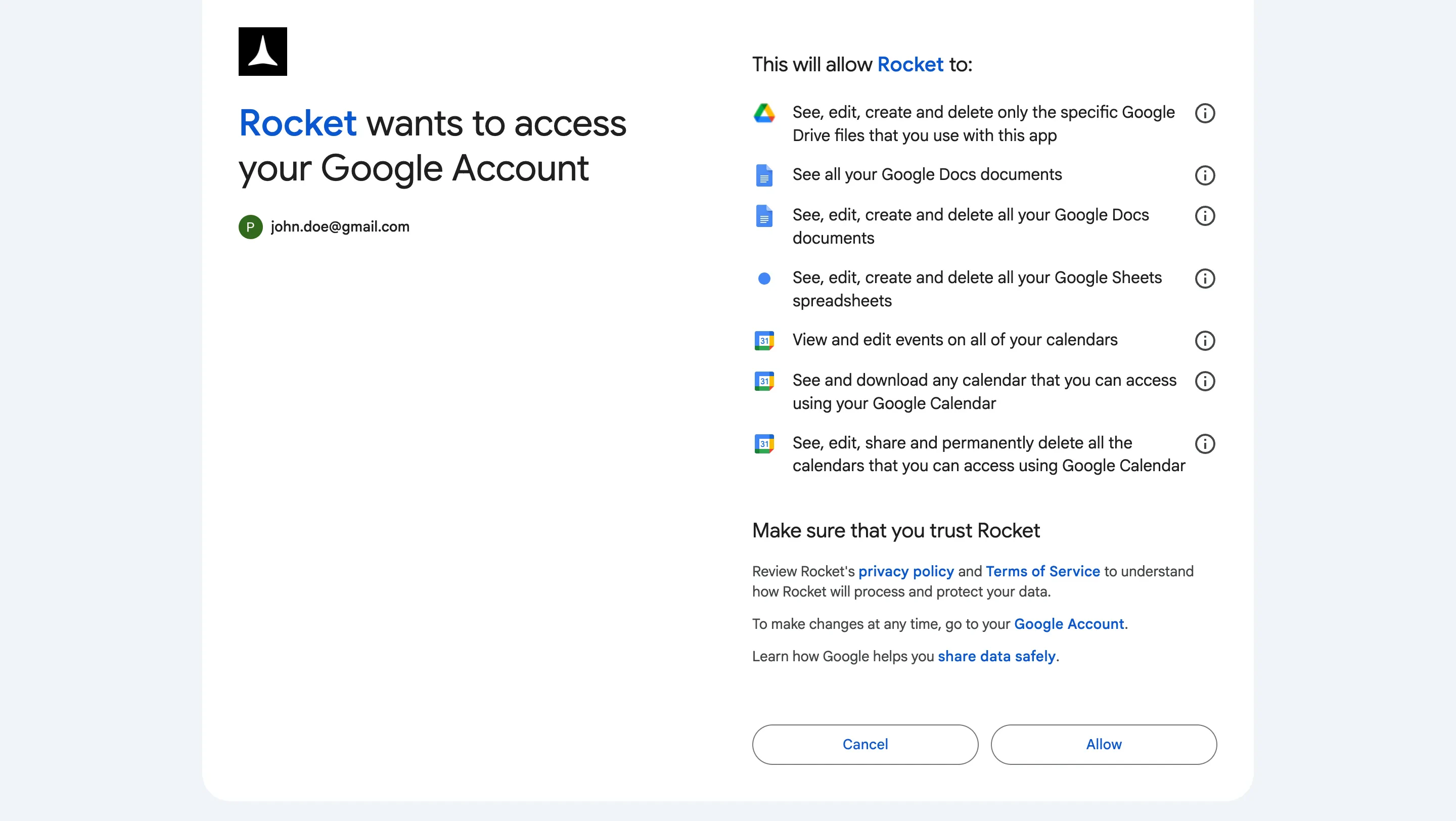
  • You will be redirected to Google’s authorization page.
  • Select the Google account you want to connect.
  • Review the requested permissions and click Allow to grant Rocket access.
A green dot next to Google Workspace in your integrations list confirms the connection.

Update or disconnect

  • Click the Google Workspace integration again.
  • Click Disconnect to remove the connection.
  • To switch accounts, disconnect and reconnect with a different Google account.

Supported services

ServiceReadWriteCommon use cases
Google DocsFull document text, headings, tables, embedded contentNew pages, reports, structured summariesBuild from specs, replace placeholder copy, generate documentation
Google SheetsColumn headers, row data, data types, formulasAppend rows, update cells, create new sheetsData-driven apps, SEO exports, content structure exports
Google DriveFile metadata, folder structure, sharing permissionsUpload files and assetsBrand asset management, file portals, document organization
Google CalendarEvents, availability, time zones, recurring eventsCreate and update eventsBooking systems, scheduling pages, event listings

Prompt cookbook

Copy-paste these prompts after connecting Google Workspace. Replace [DOCS_URL], [SHEETS_URL], and [DRIVE_URL] with your actual links.

Brand and messaging

Use casePrompt
Update hero section from brand guidelinesUpdate the hero section using my brand guidelines at [DOCS_URL]. Rewrite the headline, subtext, and CTA to match our positioning and replace placeholder imagery with assets from [DRIVE_URL].
Replace all placeholder copyRead my brand messaging doc at [DOCS_URL] and replace every placeholder on this site with real copy. Match tone, voice, and terminology from the doc.

Features and product

Use casePrompt
Update features from product specUpdate the features section using my product spec at [SHEETS_URL]. Rewrite every feature card and reorganize categories to match the doc.
Build feature comparison tableRead the competitor analysis at [SHEETS_URL] and build a feature comparison table showing our product vs. competitors with check marks and descriptions.

Pricing

Use casePrompt
Update pricing from spreadsheetUpdate the entire pricing section using my pricing matrix at [SHEETS_URL]. Replace all placeholder tiers, prices, limits, and add a billing toggle.
Build pricing calculatorRead the pricing rules from [SHEETS_URL] and build an interactive pricing calculator with sliders for usage and a monthly/annual toggle.

Social proof

Use casePrompt
Update testimonials from real quotesUpdate the social proof section using customer quotes from [DOCS_URL] and company details from [SHEETS_URL]. Replace all placeholder testimonials, logos, and metrics.
Build case study pagesRead the case study briefs at [DOCS_URL] and build individual case study pages with challenge, solution, and results sections.

Team and company

Use casePrompt
Update team section from rosterUpdate the team section using roster data from [SHEETS_URL] and bio docs from [DRIVE_URL]. Replace placeholder team members with real names, roles, and bios.
Build company timelineRead the company milestones from [SHEETS_URL] and build an interactive timeline on the about page with dates, descriptions, and images from [DRIVE_URL].

FAQ

Use casePrompt
Replace FAQ with real questionsReplace the FAQ section using real questions from [SHEETS_URL]. Add pricing, integration, and security FAQ blocks.
Build categorized knowledge baseRead the support docs at [DOCS_URL] and build a searchable FAQ page organized by category with expandable answers.
Use casePrompt
Update nav and footerUpdate the navigation and footer using my sitemap at [DOCS_URL] and brand details at [SHEETS_URL]. Fix all nav links, footer links, social handles, and contact info.

Write back to Google

Use casePrompt
Save copy for team reviewSave all copy from this landing page to Google Docs for the marketing team to review and approve.
Export SEO metadataExtract SEO metadata from this website and save page titles, meta descriptions, and keywords to a Google Sheet.
Save content for clientExport the content structure to Google Sheets with each row showing page, section, headline, body, and CTA for client review.
Generate A/B test variantsGenerate headline and CTA variants for A/B testing and save them to a Google Sheet.
Create ad copyCreate short-form ad copy for Google Ads, Meta Ads, and LinkedIn Ads from this landing page and save to Google Docs.

Tips and limitations

  • Scope your access. When connecting, grant access to specific files or folders rather than your entire Drive. You can always expand permissions later.
  • Sheets work best with clean data. Use clear column headers, consistent data types, and avoid merged cells. The cleaner the spreadsheet, the better Rocket maps it.
  • Calendar time zones. Rocket respects your calendar’s time zone settings. Double-check these before building scheduling features.
  • Write-back is additive. Rocket creates new documents or appends content. It will not overwrite existing files unless you explicitly ask it to.
  • Large files. For very large Docs or Sheets, reference specific sections or cell ranges to keep context focused and builds fast.
  • Link directly. Sharing a direct link to the Google Doc or Sheet gives Rocket the fastest path to your content. Descriptions like “my pricing spreadsheet” work too, but links are more reliable.


What’s next?