For teams building in Rocket from Azure DevOps: connect for work-item context, then set env vars so your app can call Azure DevOps APIs.
For teams who plan work in Azure DevOps and build in Rocket. Connect so you can build or fix from a work item or wiki URL and update Azure DevOps from chat. After you set env vars, your app can call Azure DevOps APIs.
You need two pieces: the connector (Azure DevOps as generation context for Rocket) and environment variables plus a PAT (so your generated app can call Azure DevOps APIs). Connect at workspace level (Settings, shared across tasks) or task level (Connectors tab or chat).
Before you start: a Microsoft account with access to the target Azure DevOps organization and project; permission to approve OAuth (or an admin if you see Need admin approval); a Personal Access Token you can create (or an admin policy that allows it); and the organization name from https://dev.azure.com/{organization} plus the project name for env vars. Use the same organization in Select Organization and AZURE_DEVOPS_ORG.
Authorize with Microsoft, then select the organization Rocket should use. You can also connect from workspace Settings.
Web Browser
Mobile App
1
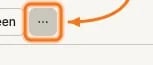
Open the overflow menu
In the preview toolbar, click the ... button.
Open the overflow menu in the preview toolbar
2
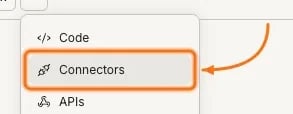
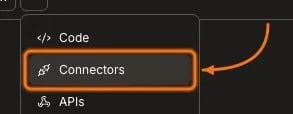
Choose Connectors
Select Connectors from the menu.
Choose Connectors from the menu
3
Open Azure DevOps
Click the Azure DevOps card.
Open the Azure DevOps connector
4
Click Connect
On the Azure DevOps connector page, click Connect.
Click Connect on the Azure DevOps connector
5
Authorize with Microsoft
A Microsoft sign-in screen opens. Sign in with an account that has access to your Azure DevOps organization, review the permissions Rocket requests, and approve access. You return to Rocket when authorization completes.
Under Select Organization, choose which Azure DevOps organization to connect, then confirm. When the connection is active, Disconnect is available on the connector page.
Reference them in server-side code as process.env.AZURE_DEVOPS_ORG, process.env.AZURE_DEVOPS_PROJECT, and process.env.AZURE_DEVOPS_PAT.
Never paste your Personal Access Token into chat, and never share passwords, OAuth tokens, refresh tokens, client secrets, or PATs with support. Add placeholders in .env, then set real values in Environment settings. If a token is exposed, revoke it in Azure DevOps and create a new one.
Pick the tab that matches what you are doing. Paste an Azure DevOps URL when you have one. Review changes in Azure DevOps before sharing; they appear in your org immediately.
Boards
Sprints
Repos
Pipelines
Wiki
Test plans
Goal
Say this in chat
Build from a story
Build the feature described in [ADO_URL]. Read the requirements, acceptance criteria, and linked items first.
Fix a bug
Fix the bug at [ADO_URL]. Read the steps to reproduce and expected vs actual behavior, then generate a targeted fix.
See my work
Show my assigned Azure DevOps work items in this project and suggest which one to build first.
Search the board
Search Azure DevOps for work items about checkout and summarize the open ones.
Create follow-ups
Create Azure DevOps tasks for QA and edge cases from this build, and link them under the parent story.
Update and comment
Move work item [ADO_URL] to Done and leave a comment describing what was built.
Goal
Say this in chat
Build from the sprint
Read my team's current sprint in Azure DevOps and build the highest-priority story first.
Check the backlog
Show the product backlog for our team and summarize what is ready to build.
See capacity
Check our team's capacity for the current sprint and call out who is overloaded.
Set up a sprint
Create a two-week sprint named Sprint 24 in Azure DevOps and assign it to our team.
Goal
Say this in chat
Match existing code
Use the repository and recent pull requests at [ADO_URL] as context so the new feature matches our patterns.
Search the codebase
Search our Azure DevOps repo for how we handle authentication and reuse that approach.
Open a pull request
Create a branch and open a pull request for the changes we just made, with a clear title and description.
Review a PR
Read the pull request at [ADO_URL], summarize the discussion, and apply any agreed fixes.
Goal
Say this in chat
Fix a failing build
Read the failing build at [ADO_URL], check the logs, and fix the issue in the app.
Check status
List our pipelines and tell me which builds failed in the last day.
Run a pipeline
Run the main build pipeline on the branch we just created.
After a build
Show the commits and work items associated with build [ADO_URL].
Goal
Say this in chat
Build from a spec
Read the wiki page at [ADO_URL] and build the described feature following those specs.
Find the right page
Search our Azure DevOps wiki for the onboarding runbook and use it as context.
Document what shipped
Create or update a wiki page summarizing what we built and how to try it.
Goal
Say this in chat
See coverage
List the test plans and suites for this project and summarize what is covered.
Results from a build
Pull the test results from build [ADO_URL] and summarize what failed.
Create cases from the build
Create a test plan with cases and steps that cover the feature we just built.